
Long Island Mortgage Rates Top 7% This Fall: How a 2-1 Buydown, a 5/1 ARM or a Seller Credit Can Cut Your Nassau or Suffolk Payment by Up to $937 a Month For the first time since January 2025, the

Dated: October 11 2024
Views: 80

Two Reasons Why the Housing Market Won’t Crash
Wednesday October 9th, 2024 Inventory, Economy
You may have heard chatter recently about the economy and talk about a possible recession. It's no surprise that kind of noise gets some people worried about a housing market crash. Maybe you’re one of them. But here’s the good news – there’s no need to panic. The housing market is not set up for a crash right now.
Real estate journalist Michele Lerner says:
“A housing market crash happens when home values plummet due to a lack of demand for homes or an oversupply.”
With that definition in mind, here are two reasons why this just isn’t on the horizon.
1. Demand for Homes Is Higher than Supply
One of the biggest reasons the housing market crashed back in 2008 was an oversupply of homes. Today, though, it’s a very different story.
It’s a general rule of thumb that a market where supply and demand are balanced has a six-month supply of homes. A higher number means supply outpaces demand, and a lower number means demand outpaces supply. The graph below uses data from NAR to put today’s situation into context:
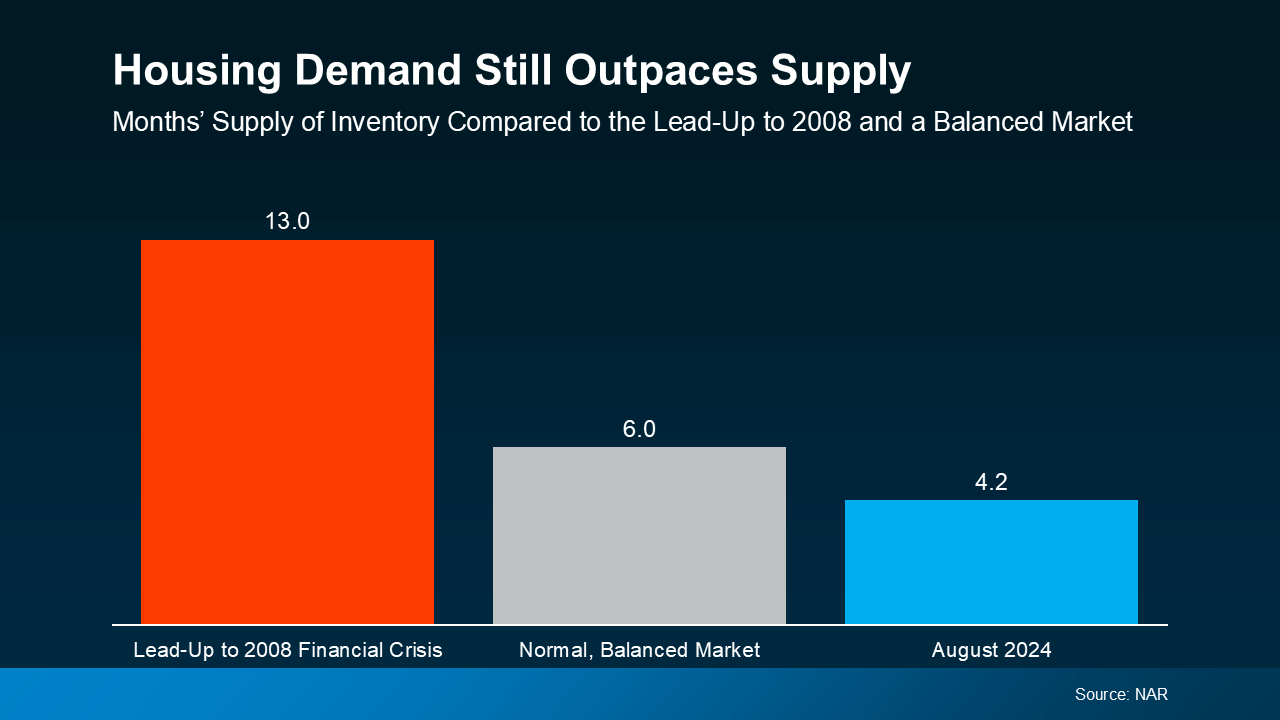
The graph compares housing supply during three different periods of time. The red bar shows there were 13 months of supply before the 2008 crisis, which was far too much. The gray bar shows a balanced market with six months of supply, for context. And the blue bar shows there are only 4.2 months of supply today.
Put simply, there are more people who want to buy homes than there are homes available to buy right now. So, demand is greater than supply. When that happens, home prices stay steady or rise – the opposite of a housing market crash.
It’s important to note that inventory levels differ from market to market. Some areas may be more balanced, while a few could have a slight oversupply, which can impact prices locally. However, most markets continue to experience a shortage of homes.
Lawrence Yun, Chief Economist at the National Association of Realtors (NAR), says:
“We simply don’t have enough inventory. Will some markets see a price decline? Yes. [But] with the supply not being there, the repeat of a 30 percent price decline is highly, highly unlikely.”
2. Unemployment Is Still Low
When people are unemployed, they’re more likely to have trouble making their mortgage payments and may be forced to sell or face foreclosure. That was a big problem during the 2008 financial crisis. Today, the employment situation is much more stable (see graph below):
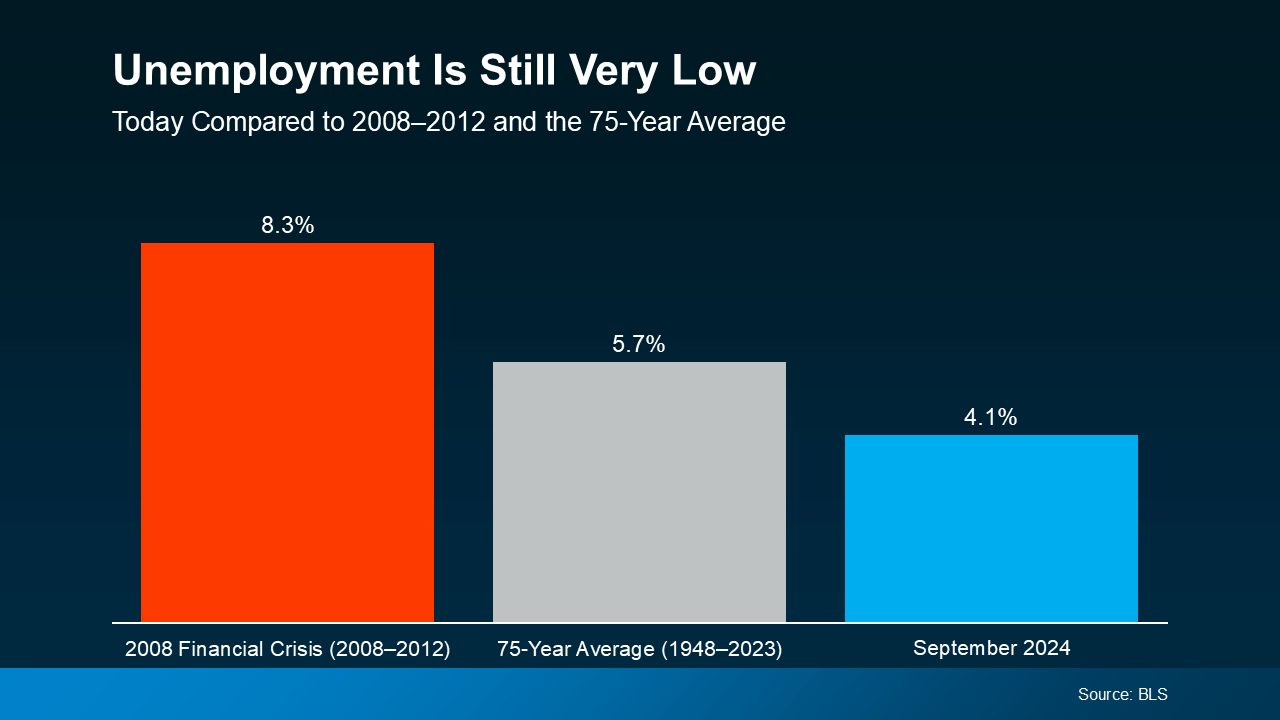
Again, this graph shows three different periods of time, but this one is the unemployment rate. The red bar represents the 2008 financial crisis when unemployment was very high at 8.3%. The gray bar shows the 75-year average of 5.7%. And the blue bar shows the unemployment rate today, and it’s much lower at just 4.1%.
Right now, people are working, earning an income, and making their mortgage payments. That’s one reason why the wave of foreclosures that happened in 2008 isn’t going to happen again this time. Plus, since so many people are employed right now, many are actually in a position to buy a home, and this demand keeps upward pressure on prices.
Today’s Housing Market Is Stronger than in 2008
While it’s understandable to be concerned when you hear talk of a recession and economic uncertainty, but know this: the housing market is in a much better place than it was in 2008. According to Rick Sharga, Founder and CEO at CJ Patrick Company:
“Literally everything is different about today’s housing market dynamics than the conditions that led to the housing crisis.”
Demand for homes still outpaces supply, and unemployment remains low. And these are two key factors that will help prevent the housing market from crashing any time soon.
Bottom Line
The housing market is doing a lot better than it was in 2008, but it’s important to remember that real estate is very local.
So, it’s always a good idea to stay informed about our specific market. If you have any questions or want to discuss how these factors are playing out in our area, feel free to reach out.
Best Realtor In Syosset, Best Syosset Realtor, Giulio Ferrante, Signature Premier Properties
#BuySellHomesLI
#SignaturePremierProperties
#ListYourHome
#SellYourHome
#RealEstate
#LongIslandHomes
#LIRealEstate
#LongIslandRealtor
#NYRealEstate
#HomeBuyersLI

Giulio Ferrante is a Licensed Real Estate Salesperson with Signature Premier Properties, specializing in Syosset and Long Island’s North Shore. Recognized by FastExpert as a 2026 Top Agent in Sy....
Long Island Mortgage Rates Top 7% This Fall: How a 2-1 Buydown, a 5/1 ARM or a Seller Credit Can Cut Your Nassau or Suffolk Payment by Up to $937 a Month For the first time since January 2025, the
Long Island Home Prices Top $900,000 as Mortgage Rates Break 7%: What the Fed's September Hike Means for Nassau and Suffolk Buyers and Sellers This Fall Two numbers landed on Long Island within a
Median sale prices tell you what a house cost. Price per square foot tells you what you actually bought. Right now on Long Island that number ranges from about $365 a square foot in parts of South
Long Island Real Estate Attorney Fees and the Contract Timeline in 2026: What a $2,250 Flat Fee, an $84,000 Escrow Deposit and 2-7 Days of Attorney Review Really Mean for Your Nassau or Suffolk
 OneKey® MLS required Copyright, Source of Data and Disclaimer for IDX display
Information Copyright 2026, OneKey® MLS. All Rights Reserved.
The source of the displayed data is either the property owner or public record provided by non-governmental third parties. It is believed to be reliable but not guaranteed. This information is provided exclusively for consumers' personal, non-commercial use.
The data relating to real estate for sale on this website comes in part from the
IDX Program of OneKey® MLS.
OneKey® MLS required Copyright, Source of Data and Disclaimer for IDX display
Information Copyright 2026, OneKey® MLS. All Rights Reserved.
The source of the displayed data is either the property owner or public record provided by non-governmental third parties. It is believed to be reliable but not guaranteed. This information is provided exclusively for consumers' personal, non-commercial use.
The data relating to real estate for sale on this website comes in part from the
IDX Program of OneKey® MLS.
33. Required DMCA Notice
The Digital Millennium Copyright Act of 1998, 17 U.S.C. §512, the DMCA, provides recourse for copyright owners who believe that material appearing on the Internet infringes their rights under U.S. copyright law. If you believe in good faith that any content or material made available in connection with our website or services infringes your copyright, you (or your agent) may send us a notice requesting that the content or material be removed, or access to it blocked. Notices must be sent in writing by email to DMCAnotice@MLSGrid.com. The DMCA requires that your notice of alleged copyright infringement include the following information: (1) description of the copyrighted work that is the subject of claimed infringement; (2) description of the alleged infringing content and information sufficient to permit us to locate the content; (3) contact information for you, including your address, telephone number and email address; (4) a statement by you that you have a good faith belief that the content in the manner complained of is not authorized by the copyright owner, or its agent, or by the operation of any law; (5) a statement by you, signed under penalty of perjury, that the information in the notification is accurate and that you have the authority to enforce the copyrights that are claimed to be infringed; and (6) a physical or electronic signature of the copyright owner or a person authorized to act on the copyright owner\'s behalf. Failure to include all of the above information may result in the delay of the processing of your complaint.
Show More...